7 tips for home working success based on neuroscience

If you're having to work from home, look after your children and lead a team of people right now you'll know that it's NOT EASY. It's a testing time for us all but thankfully there are some simple actions you can take right now that will help your brain to focus and be less distracted.
The unprecedented measures have rightly been taken to slow the spread of Coronavirus across the world. None of us really know what impact self-imposed isolation will have on our personal and professional lives.
What is certain is that it will take considerable personal discipline and adaptability if we wish to work effectively during this uncertain time.
Each personality type will tackle this situation differently. People have a different way of handling change, different resources available to pull on. We will also all be at different stages of the Kubler-Ross Change Curve. Some under-reacting, some over-reacting, but we need to be Adaptors.
What stage are you? What about those in your team? What about your loved ones? The best thing you can do is ask them. Ask them to name the emotion in 1 or 2 words. Then support them to regulate, step into action with what feels right to them at this time.
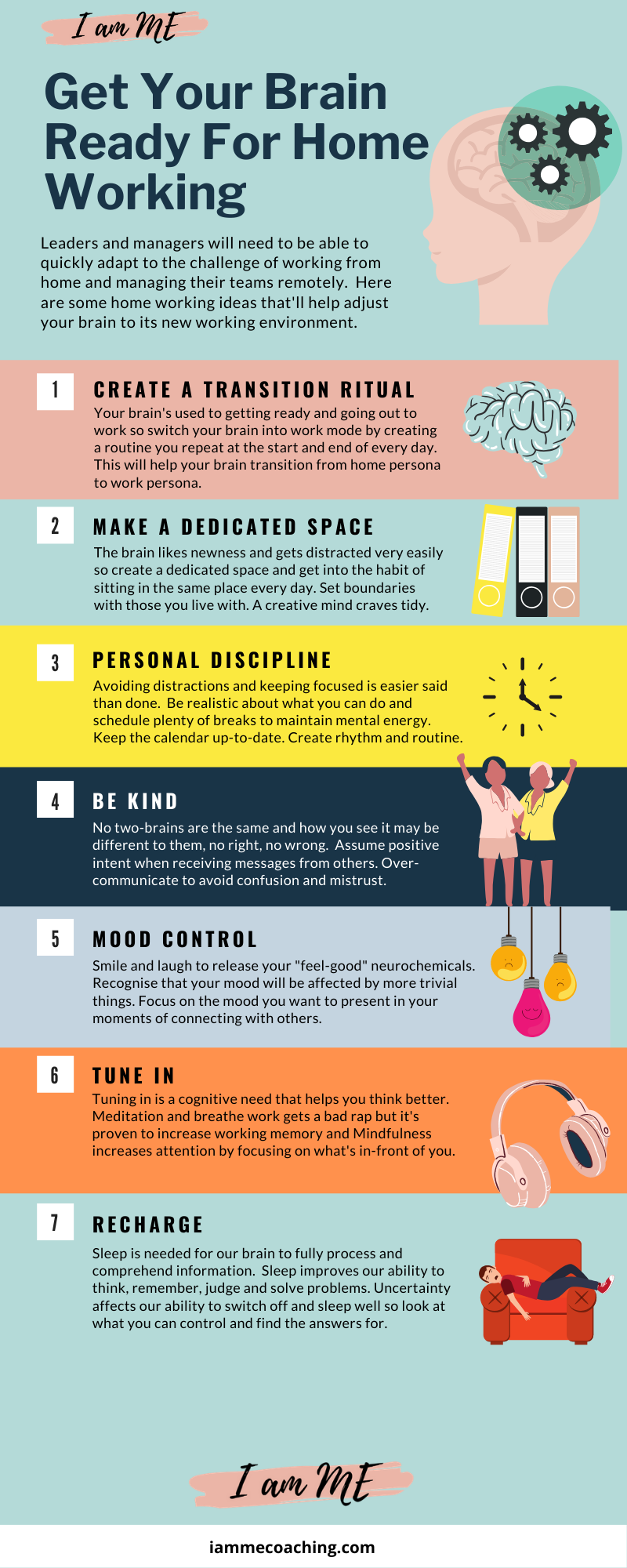
I’ve put together an infographic to highlight some tips to make home working a success based on neuroscience and our insight into how the brain works and the need to create new working habits and connections in your brain.
One of the greatest challenges of virtual working is that it's much harder for people to speak about how they're feeling than when you are hanging out together. Upping your 1:1 contact can support this. So can virtual working hours - you can have Zoom on and work together side-by-side but you're there for questions as they arise. 10-minute stand-up meetings are also good as a little motivation each day. As a leader, it's time to show up with confidence.
What they need from you...
1. Certainty - communicate well and often - what else do they need from you? What do they want to know? Share as much as you can on a regular basis even if there's no update at all.
2. Autonomy - what ideas do they have for managing their time and the tasks they need to do? Can you share tips on the things they can control (e.g. their work set up, their hours, the to-do list)?
3. Relatedness - what do they need to feel connected and happy?
How to work from home: 7 tips based on Neuroscience
1. TRANSITION RITUALS
Establishing a consistent morning routine helps you to 'switch on' and 'switch off' to work. Creating a clear routine in the morning and at the end of each workday can help as it signals the transitions from your home persona to your work persona.
2. CREATE A DEDICATED SPACE
A dedicated space that you can separate from your home life, and can leave at the end of the work-day. Create rules and boundaries with the people who share your home so that you're not disturbed as often.
The brain loves newness and we get distracted in new surroundings. We focus better when we work in a familiar environment. Creative minds love tidiness.
3. PERSONAL DISCIPLINE
Make no mistake, it will be hard to avoid distraction and stay focused. Create a timetable for your day with plenty of breaks scheduled (at least every 90 mins as our energy tends to oscillate in 90-mins waves). Be realistic about what you can do and aim to tackle your most important tasks at the start of each day on a rested brain.
Don't waste this great 'thinking time' on checking emails use it instead for problem-solving and creative thinking. Find a rhythm and routine for your week - it may take a while to find your groove.
4. BE KIND
No two brains are the same and how you see it may be different to them, no right, no wrong. So, assume positive intent when receiving messages from others.
Try to over-communicate and provide updates as much as possible and let them know you are there for them. Pre-empt confusion and mistrust and make the intrinsic, extrinsic.
5. MOOD CONTROL
Recognise that your mood will become affected by trivial things. Focus on the mood you present in the rarer moments of connection with your team and your loved ones. Laughter releases endorphins that make you feel relaxed and less stressed.
Even forcing a smile has been shown to have the same effect. If you need extra support, reach out to the people in your life who lift you up. Watch or read things that make you laugh.
6. TUNE IN
Tuning-in is a cognitive need that helps you think better. Meditation and breathe work gets a bad rep but it's proven to increase working memory. Mindfulness increases attention by focusing on what's in front of you.
Studies show than when practised on a regular basis, it helps regulate emotion, reduces stress, improves creativity and attention. It can also reduce symptoms of anxiety and depression.
Tuning-in or Mindfulness is not a state we are likely to enter into it easily without practice. Find time to reflect focusing on sensations, images, feelings and thoughts. For example, think about 5 things you can see, 4 you can feel, 3 hear, 2 smell, 1 taste. This will help better integrate the brain and increases attention.
Let's be realistic, finding the time for mindfulness meditation isn't going to be easy right now. You may even think it's selfish to even try. Try and banish those thoughts as if we're to look after other people, we need to take care of ourselves as well.
7. RECHARGE
Sleep is needed for our brain to fully process and comprehend information. Sleep improves our ability to think, remember, judge and solve problems. Uncertainty affects our ability to switch off and sleep well. Focusing on what you can influence and control will ease your anxiety.
Soak the good stuff into your brain as you go to sleep, you may find gratitude helps with this or simply reading a good book will help you to take your mind off things.
